


centro virtual de arte argentino

Menú

Algunos dossiers

Marino Santa María
Calle Lanín
Calle Lanín
por
Adriana Lauria y Enrique Llambías
Abril de 2009
Abril de 2009
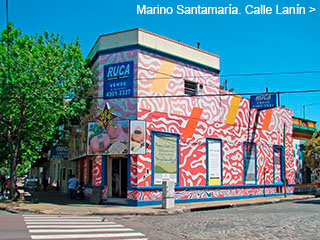
Con su labor de la última década Marino Santa María es uno de nuestros más prolíficos artistas públicos. Calle Lanín es, sin lugar a dudas, una obra singular, no sólo por sus dimensiones sino también por las complejidades que encierra. La introducción y la antología han sido elaboradas especialmente para este estudio por Georgina Gluzman y Valentina Mellado.
Christine Castro Gache. “Colour as a spell”, en diario The Buenos Aires Herald, Buenos Aires, domingo 15 de abril de 2001, p. 12.
“I have always felt the urge to do urban art,” noted Marino Santa María. “Once upon a time, the walls used to be gray and engraved with fissures, but colour revived the old houses.” The inhabitants themselves felt pigments running through their veins. “Joy reached such a point that they either selected the colour of their houses, or said: you choose. What’s more, people began redecorating their interiors. This is what public art generates in forgotten neighbourhoods: a new life is bestowed upon them.” One of a kind: not only does he transform as part of his nature, but manifests a profound humanistic pleasure in doing so. “It is through community art that I transmit, that the lonesomeness of the creator facing his canvas is annulled. This allows for an expansion of the self that reduced works do not permit.” Santa María’s gregarious personality oozes from each of the modest homes that border the railroad. Curves, diagonals, patches, they all romp like happy, chromatic children, in harmony with the constant rumbling of trains [...]
“I wanted to modify the image people commonly have when alluding to a neighbourhood located in the south of the city, in place of the typical malevo, standing cigarette in mouth against a lamp-post, I believe a change is imperative: Barracas has to be viewed from a novel perspective, it must become an enclave of contemporary art” Santa María smiled, contented. “I was born on 33 Lanín Street, in 1949.” [...] “It is here that I played, quarrelled with my friends, had my first girl-friend. This public art project is my childhood repainted.” [...]

